
Ben Ivany Photography
Vancouver Island Wolf
(canis lupus crassodon)


Over the course of six years living in a small community on Vancouver Island, I've been able to shed a sliver of light onto an enigmatic ghost of the rainforest. The Vancouver Island Wolf. Most of my knowledge about their behaviour has come from reading, and piecing together clues. Tracks, distant howls, stories from other people. Seldom do they show themselves. I place them in a category with Cougars in my mind - of animals that live alongside us - share land, space, trails with us - but seem to almost exist in a parallel reality, one of utmost patience and precaution. But every now and then, the fabric between our world and theirs becomes thin and they slip into the light before us. Time is suspended, and our gazes lock. Here, a strange contradiction of the wolf is revealed - they seem to avoid people at all costs, until there is one in front of them. Then, in all of my encounters (admittedly, only eight) there has been an extended moment of curiosity, where the wolf and I are staring at one another. A shared moment of respect between apex predators. These moments make me think of ancient interactions between wolves’ ancestors and our own. Were exchanges like this the first step to establishing a mutual relationship that would eventually become domestication?
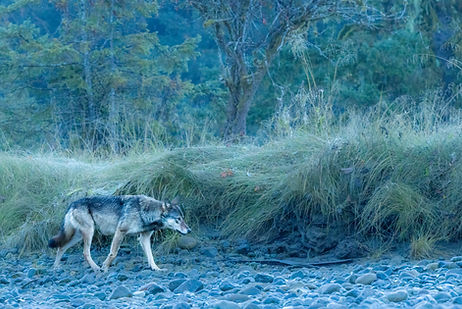
A classic example of a coastal 'Sea Wolf' on a remote beach. Patrolling the intertidal zone at low tide.
In the dim pre-dawn light, I spotted this wolf some distance away, staring at me. She spooked upriver, but within minutes had reappeared in front of me, staring. She even walked directly towards me for a moment before losing interest.

A wolf with a very relaxed disposition. He was comfortable enough with me to spend some time mousing and even laying down in my presence.
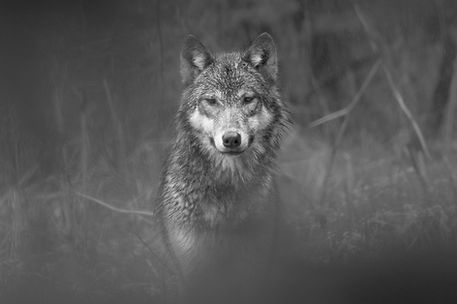
This wolf and I surprised each other while we were covering ground in opposite directions. We locked eyes through the branches of a Sitka Spruce, then went our separate ways.
North American Canid genealogy is a bit of a contentious mess, but the Vancouver Island Wolf (canis lupus crassodon) is widely regarded as a distinct subspecies of the North American Gray Wolf (canis lupus), and many sources point to physical and behavioural differences between them and the wolves of the mainland. They tend to be smaller, with lighter coats. Many feature a light, golden brown that is not common among mainland wolves. Appearance aside, what really sets them apart is their decidedly marine inclination. They live by the tides, sometimes taking up to ninety percent of their food from the Ocean. Sea Otters are a surprising favourite, but they eat lots of other marine meats, from limpets and crabs to beached whales. They have been known to swim 12km (7.5 miles) across the Ocean, often between islands. These charismatic, semiaquatic wolves are the subject of much fascination and have been given the evocative name of ‘Sea Wolf’.
While the name 'Sea Wolf' is perfectly applicable to most of the Island's wolves , there are some Vancouver Island Wolf packs that seldom spend any time by the Ocean. I think it is painting with too broad a brush to use the names Vancouver Island Wolf (canis lupus crassodon) and Sea Wolf interchangeably. The behavioural spectrum between wolf packs around Vancouver Island is varied and fascinating.
Each pack has evolved its own dynamics, migratory routes, territories, hunting preferences , and - ultimately - culture. Wolves are intelligent, social animals who learn, adapt and pass learned knowledge on to their pack mates and offspring. There are truly coastal packs that excel at beach-combing and hunting marine mammals, and rarely stray far from the coast. Conversely, the pack I have become somewhat acquainted with lives more like their mainland cousins - they spend long periods of time far from the open Ocean, and seem to be sustained mostly by deer, elk, rodents, and large waterfowl. But as is always the case in the natural world, variation is the only constant. Even the most oceanic wolf packs will venture inland and take ungulates. Some of the more landlocked wolves will head out to the ocean to capitalize on events like the Herring spawn and the Salmon run. Every pack has inherited ancestral knowledge of which parts of their territory are more bountiful throughout different parts of the year, and they are constantly refining that temporal food map. Wolves cover lots of ground, and in times of scarcity, packs will split up and explore different locations.